

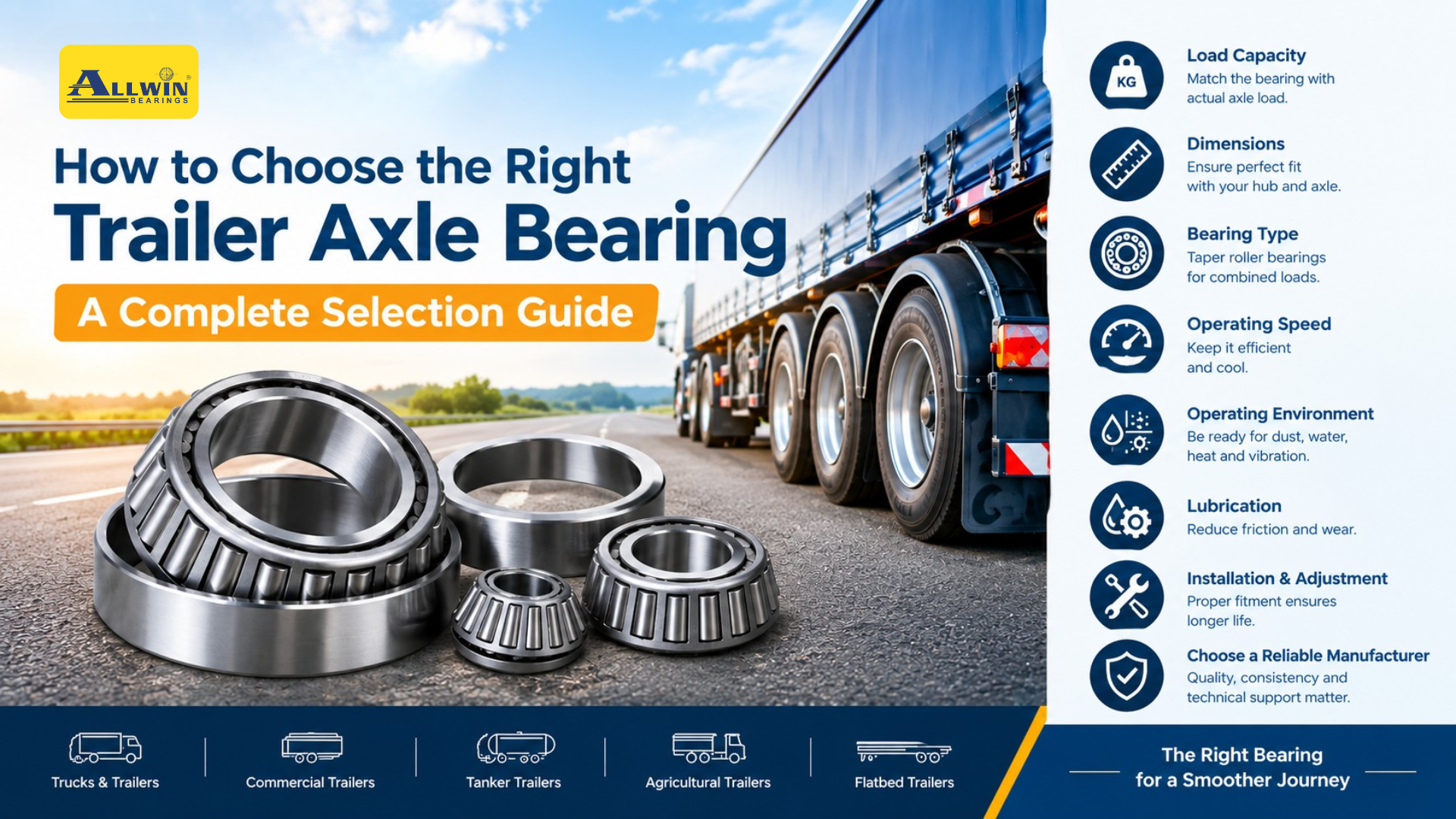
Choosing the right trailer axle bearing is an important decision for trailer manufacturers, axle manufacturers, distributors and fleet operators. The correct bearing helps support the wheel-end assembly, manage operating loads and maintain smooth wheel rotation under demanding road conditions.
However, selecting a bearing should not be based only on its size or price. Bearing dimensions, load requirements, operating conditions, lubrication, speed, installation and expected service life all need to be considered.
In this guide, we explain how to choose the right trailer axle bearing and what OEMs should check before purchasing.
A trailer axle bearing operates continuously while the trailer is carrying its load and travelling on the road.
During operation, the bearing may experience:
If the bearing is not suitable for the application, it may experience excessive wear, heat generation, noise or premature failure.
Choosing the correct bearing from the beginning can help improve wheel-end reliability and reduce unexpected maintenance requirements.
The first step in selecting a trailer axle bearing is understanding where and how it will be used.
Different trailers can have significantly different operating requirements.
Consider whether the bearing will be used in:
A bearing suitable for one application may not automatically be suitable for another.
The trailer’s axle design, operating environment and expected duty cycle should always be considered.
Load capacity is one of the most important factors when selecting a trailer bearing.
The bearing may need to support loads generated by:
The number of axles and wheels also affects how the total load is distributed.
For a more detailed explanation, see our guide to Trailer Axle Bearing Load Capacity.
A bearing should be selected according to the actual axle and wheel-end application rather than simply choosing the largest available bearing.
Correct dimensions are essential for proper installation.
Important dimensions include:
The inner diameter must correctly match the axle or spindle.
The outside diameter must be compatible with the hub or housing.
The overall width must be suitable for the available installation space and assembly.
For tapered roller bearing arrangements, both the cup and cone must be correctly matched to the application.
Before ordering, OEMs should verify the bearing number and dimensions against their axle and hub specifications.
Different bearing designs are suitable for different applications.
Taper roller bearings are commonly used in trailer axle and wheel-end applications because their design can accommodate radial and axial loads.
A tapered roller bearing generally consists of:
The tapered geometry allows the bearing to manage combined loading conditions.
However, bearing type should always be selected according to the specific engineering requirements of the axle assembly.
Trailer wheel bearings rotate whenever the trailer is moving.
Operating speed depends on factors such as:
Speed affects friction and heat generation.
Therefore, the selected bearing should be appropriate for the expected operating speed and temperature range.
For heavy-duty applications, the complete bearing arrangement should be evaluated rather than looking at load capacity alone.
The road environment can have a significant effect on bearing performance.
Trailer axle bearings may encounter:
If the trailer operates in harsh conditions, sealing, lubrication and contamination protection become particularly important.
A bearing specification that works well in a controlled environment may require different considerations for off-road, agricultural or heavy-duty applications.
Bearing performance depends heavily on manufacturing quality.
Important factors include:
Consistent manufacturing helps ensure that bearings meet their intended specifications from one production batch to another.
For OEM customers, consistency is particularly important because hundreds or thousands of bearings may be installed across different axle assemblies.
Lubrication helps reduce friction and heat while protecting bearing surfaces.
Before selecting a bearing, manufacturers should understand:
Insufficient or incorrect lubrication can reduce bearing performance even when the bearing itself has been correctly selected.
Lubrication practices should follow the recommendations applicable to the specific bearing and axle system.
A high-quality bearing can still experience problems if it is installed incorrectly.
Installation should take into account:
For tapered roller bearing arrangements, correct adjustment is particularly important.
Incorrect adjustment can result in excessive play, increased friction or abnormal operating temperature.
Manufacturers should follow the applicable bearing and axle manufacturer’s installation procedures.
The supplier you choose is just as important as the bearing specification.
When evaluating a trailer axle bearing manufacturer, consider:
Look for a manufacturer with experience in automotive, trailer or industrial bearing applications.
Ask about inspection procedures for dimensions, roundness, surface finish, hardness and other important characteristics.
OEM customers may require specific dimensions, packaging, labelling or production quantities.
A manufacturer should be capable of supporting repeat orders and maintaining consistent quality.
A good bearing supplier should be able to understand the application and help identify a suitable bearing specification.
For international buyers, export packaging, documentation and logistics support can also be important.
Several mistakes can lead to poor bearing performance.
The lowest purchase price does not necessarily provide the lowest overall operating cost.
A bearing can have the correct dimensions but still be unsuitable for the application’s load or operating conditions.
Road shocks, braking and cornering can create additional forces beyond the basic static trailer load.
Poor lubrication can cause premature wear and overheating.
The bearing number should always be checked against the actual axle, hub and operating requirements.
Allwin Bearings manufactures bearing solutions for automotive, agricultural and industrial applications.
Its product range includes taper roller bearings, wheel hub bearings, ball bearings, cylindrical roller bearings and spherical roller bearings.
For trailer applications, Allwin provides bearing solutions for different trailer and heavy transport requirements, including OEM and export applications.
The company focuses on manufacturing characteristics such as material quality, dimensional control, surface finish, roundness and bearing performance.
If you are looking for a trailer axle bearing manufacturer for OEM, replacement or export requirements, Allwin Bearings can evaluate your application and bearing specifications.
Before placing an order, confirm:
Choosing the right trailer axle bearing requires more than matching a part number.
The correct selection should consider load capacity, bearing dimensions, bearing type, operating speed, road conditions, lubrication, installation and manufacturing quality.
For trailer manufacturers and OEMs, working directly with an experienced bearing manufacturer can make the selection process easier and help ensure consistent product quality.
If you need a bearing for a specific trailer axle application, provide the bearing number, dimensions, axle specifications and operating requirements to the Allwin Bearings team.
Explore Allwin Bearings’ Trailer Axle Bearing solutions for OEM, replacement and export requirements.
Allwin Bearings LLP — Precision Engineered. Globally Trusted.