

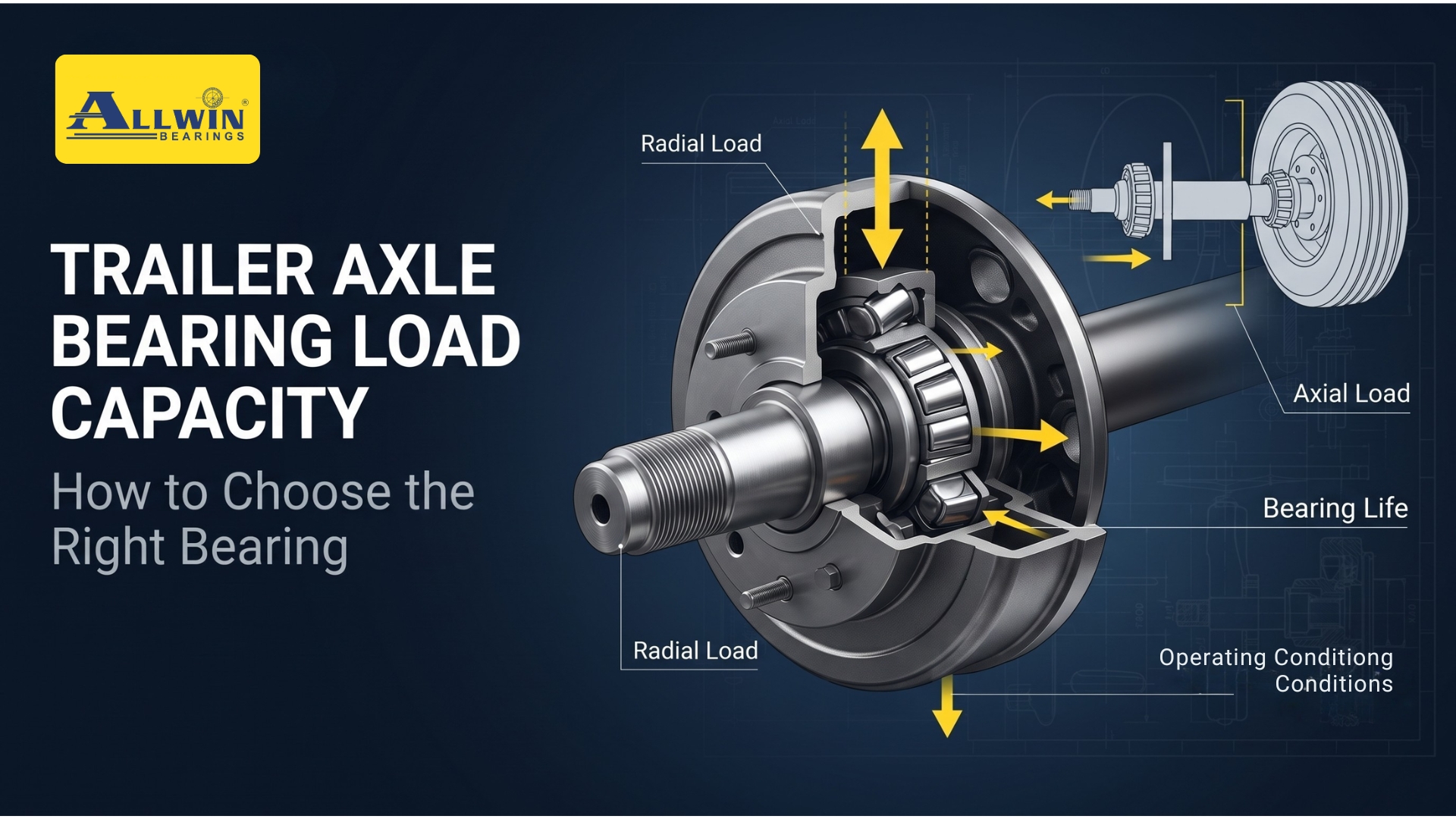
When selecting a trailer axle bearing, load capacity is one of the most important factors to consider. Trailer bearings operate under continuous loading while the vehicle carries cargo, travels over different road surfaces and experiences braking, turning, vibration and shock.
Choosing a bearing only by its physical dimensions or part number may not be enough. The bearing must be suitable for the actual operating conditions of the trailer axle.
In this guide, we explain trailer axle bearing load capacity, the different loads a bearing experiences, the factors that affect bearing selection and what OEMs should consider when sourcing bearings.
Trailer axle bearing load capacity refers to the ability of a bearing to support the loads generated during trailer operation while maintaining reliable rotation and acceptable operating conditions.
A trailer axle bearing can experience different types of loads, including:
The actual load experienced by a bearing is not necessarily equal to the trailer’s total cargo weight. Load distribution depends on the axle configuration, number of wheels, number of axles, hub arrangement, road conditions and operating conditions.
Therefore, bearing selection should be based on the complete axle and wheel-end application rather than cargo weight alone.
The bearing is continuously supporting and transferring loads while the trailer is moving.
A correctly selected bearing can help support:
If the bearing is not suitable for the application’s loading conditions, excessive stress can develop within the rolling elements and raceways.
This may result in increased temperature, abnormal wear, vibration or premature failure.
For OEMs, selecting the correct bearing load capacity is therefore an important part of designing a reliable wheel-end and axle assembly.
Radial load acts perpendicular to the bearing’s rotational axis.
In trailer applications, radial load is generated primarily by:
The actual radial load varies depending on how weight is distributed across the trailer axles.
Axial load acts along the rotational axis of the bearing.
Trailer bearings can experience axial forces during:
This is one reason taper roller bearings are widely used in applications where both radial and axial loads need to be accommodated.
A trailer does not operate under perfectly constant loading.
Potholes, uneven roads, braking, acceleration and sudden changes in direction can create dynamic forces.
For this reason, engineers should consider the expected duty cycle and operating environment rather than selecting a bearing based only on a simple static load calculation.
There is no single load rating that is suitable for every trailer.
Bearing selection should consider several factors.
Start with the expected operating load of the trailer.
Consider:
The bearing should be selected according to the manufacturer’s engineering requirements for the specific axle and hub arrangement.
Load capacity cannot be considered separately from bearing dimensions.
Important dimensions include:
The bearing must match the axle spindle and hub configuration correctly.
A bearing with an apparently suitable load rating can still be unsuitable if its dimensions or mounting arrangement do not match the application.
The rotational speed of a trailer wheel depends on wheel diameter and vehicle speed.
Operating speed affects friction and heat generation within the bearing.
Therefore, the selected bearing should be appropriate for the expected operating speed and temperature range.
A trailer operating on smooth highways may experience different conditions from one operating on rough roads or construction sites.
Engineers should consider:
These conditions can influence the bearing’s expected service life.
Operating a bearing beyond its intended loading conditions can increase stress on the rolling elements and raceways.
Potential consequences include:
High loading can increase contact stress and accelerate surface wear.
Higher friction and load can increase operating temperature.
Excessive or repeated loading may contribute to surface fatigue or other forms of damage.
Damaged rolling surfaces can cause abnormal noise and vibration during operation.
A bearing operating outside its intended conditions may require earlier replacement.
For this reason, bearing load capacity should always be evaluated as part of the complete application.
Load capacity is not the only factor affecting bearing life.
Lubrication also plays an important role.
The correct lubricant helps control:
Incorrect lubrication, insufficient lubricant or contamination can negatively affect bearing performance even when the bearing has been correctly selected for the load.
The lubricant type and service procedure should follow the recommendations applicable to the specific bearing and axle system.
Two bearings with similar dimensions may not necessarily provide identical manufacturing consistency.
Important manufacturing characteristics include:
Consistent manufacturing is particularly important for OEM applications where large quantities of bearings are installed across multiple axle assemblies.
A reliable Trailer Axle Bearing supplier should therefore be evaluated not only on price but also on manufacturing consistency, quality control and application support.
A part number may identify a bearing, but the application still needs to be checked for load, speed and operating conditions.
The same trailer weight can create different bearing loads depending on the axle and wheel configuration.
Actual operation includes dynamic forces, vibration and shock loading.
Incorrect mounting, fitment or adjustment can negatively affect bearing performance.
Even a properly selected bearing can experience premature problems if lubrication is inadequate or contaminated.
Before placing an OEM order, manufacturers should discuss:
These questions help OEMs evaluate a bearing supplier beyond simply comparing product prices.
Trailer axle bearing load capacity is an application-specific engineering consideration.
The correct bearing depends on more than the weight of the trailer. Engineers should evaluate radial and axial loads, axle configuration, bearing dimensions, operating speed, road conditions, lubrication and expected service life.
For OEMs and trailer manufacturers, working with an experienced bearing manufacturer can help ensure that the selected bearing is appropriate for the complete wheel-end application.
Allwin Bearings supplies bearing solutions for automotive, agricultural and industrial applications, including trailer axle applications.
If you are sourcing bearings for OEM production, replacement requirements or export markets, provide your bearing number, dimensions, axle application and operating requirements to the Allwin Bearings team.
Explore Allwin Bearings’ Trailer Axle Bearing solution:
Allwin Bearings LLP — Precision Engineered. Built for Reliability.