

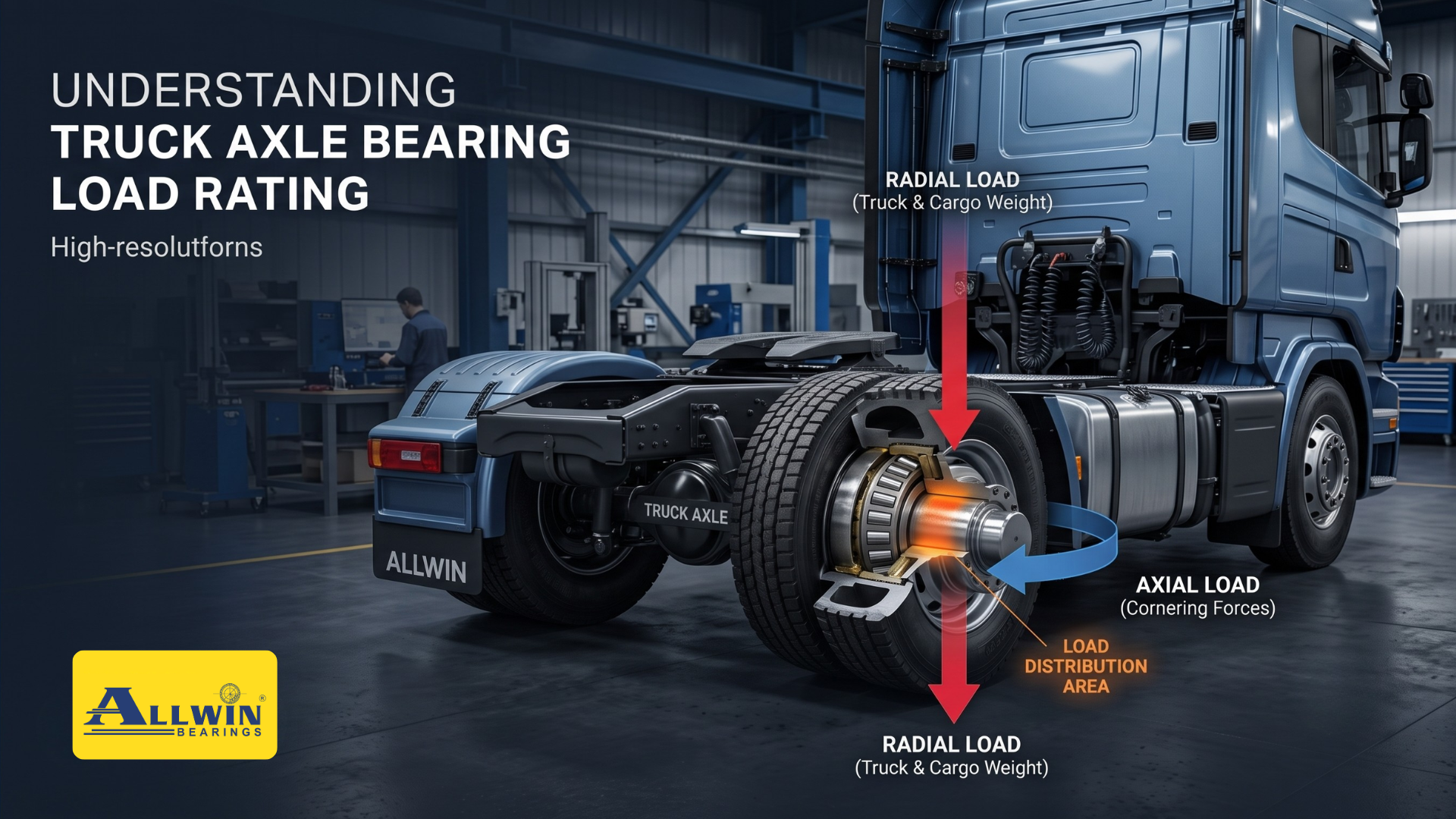
A trailer may carry several tons of cargo over thousands of kilometres, but the reliability of that journey often depends on components that are rarely visible. One of the most important among them is the trailer axle bearing.
A properly selected trailer axle bearing supports wheel rotation, handles radial and axial loads, reduces friction and helps the axle system operate reliably under demanding road conditions.
For trailer manufacturers, axle manufacturers, distributors and fleet operators, choosing the correct bearing is not simply a matter of matching dimensions. Load requirements, bearing type, operating conditions, lubrication, installation and manufacturing quality all influence bearing performance.
In this guide, we explain what a trailer axle bearing does, the types commonly used, important selection factors, common failure causes and how manufacturers can choose the right bearing supplier.
A trailer axle bearing is a precision mechanical component installed within the wheel hub or axle assembly. Its primary function is to allow smooth wheel rotation while supporting the loads generated during trailer operation.
During operation, the bearing can experience:
Because trailer applications can involve heavy loads and extended operating periods, bearing selection plays an important role in overall axle reliability.
A suitable trailer axle bearing helps maintain smooth rotation, proper wheel alignment and dependable operation throughout the intended service life.
The bearing may be a relatively small component, but its operating environment can be demanding.
A properly engineered bearing can contribute to:
The bearing reduces friction between moving components and allows the trailer wheel to rotate smoothly.
Trailer axle bearings must support the radial loads generated by the trailer, cargo and road conditions while also accommodating relevant axial forces.
Consistent bearing dimensions, correct fitment and suitable internal geometry contribute to reliable axle operation.
Appropriate material, heat treatment, surface finish, lubrication and installation can help reduce premature wear.
A bearing manufactured and selected according to the application can withstand repeated load cycles and demanding operating conditions.
Unexpected bearing failure can result in downtime and additional maintenance. Proper bearing selection and inspection can help reduce these risks.
Taper roller bearings are commonly used in trailer axle applications because their design can accommodate both radial and axial loads.
A tapered roller bearing consists primarily of:
The geometry allows the rollers to distribute loads across the raceways while supporting the combined loading conditions encountered in many axle applications.
However, the correct bearing should always be selected according to the specific axle design, dimensions, load requirements and operating conditions rather than simply choosing a bearing based on application name.
Selecting a trailer axle bearing requires consideration of several engineering factors.
Load capacity is one of the first factors to evaluate.
The bearing should be capable of handling the expected radial and axial loads generated during normal operation as well as relevant dynamic conditions.
Consider:
Selecting a bearing based only on maximum static load may not provide a complete picture of real-world performance.
Correct dimensions are essential for proper fitment.
Important dimensions include:
Even a small dimensional mismatch can affect assembly, alignment and bearing performance.
Trailer wheel bearings operate at different speeds depending on wheel diameter and vehicle speed.
The selected bearing should be appropriate for the expected operating speed and temperature conditions.
A trailer axle does not operate in a controlled environment.
Bearings may be exposed to:
The bearing arrangement, sealing and lubrication system should therefore be suitable for the application.
Lubrication is essential for controlling friction and heat.
Incorrect lubricant selection, insufficient lubrication or contamination can accelerate wear and may lead to premature bearing problems.
The lubricant and lubrication quantity should be selected according to the bearing and axle manufacturer’s requirements.
Dimensional accuracy has a direct relationship with fitment and bearing performance.
Important manufacturing parameters can include:
Consistent manufacturing becomes particularly important for OEM customers producing large quantities of trailer axle assemblies.
A trailer axle bearing can fail for several reasons. The bearing itself is not always the only cause.
Common causes include:
Incorrect installation force, alignment or mounting procedure can damage bearing components or create uneven loading.
Too much or too little preload can affect friction, operating temperature and service life.
Inadequate lubrication can increase friction and heat, accelerating wear.
Dust, dirt and moisture can damage rolling surfaces and degrade lubricant performance.
Operating beyond the intended load conditions can increase stress on the bearing and surrounding components.
Misalignment can produce uneven contact and localized loading, potentially accelerating wear.
Variations in material quality, heat treatment, dimensional accuracy or surface finish can affect bearing performance.
Regular inspection can help identify potential problems before a major failure occurs.
Some warning signs may include:
The appropriate inspection and replacement procedure should follow the trailer, axle and bearing manufacturer’s recommendations.
For commercial trailers, bearing performance is connected to the reliability of the complete wheel-end system.
A consistent trailer axle bearing can help support:
Reliable wheel rotation → dependable axle operation → reduced maintenance interruptions → better vehicle uptime
This becomes particularly important for OEMs and fleet operators where unexpected downtime can affect delivery schedules and operating costs.
For OEM applications, consistency from one production batch to another is also important because dimensional variation can affect assembly and interchangeability.
For an OEM or distributor, selecting a supplier involves more than checking the bearing catalogue.
Consider evaluating:
Can the supplier consistently manufacture the required bearing type and dimensions?
Does the manufacturer have controlled inspection processes for dimensions, hardness, surface finish and other important parameters?
The bearing steel and heat-treatment process influence durability and fatigue performance.
Consistent dimensions are important for repeatable OEM assembly.
A capable supplier should understand the application rather than simply supplying a bearing based on a part number.
For OEMs and distributors, the supplier should have the ability to maintain consistent supply for recurring orders.
International customers may also need suitable packaging, documentation, logistics support and consistent production quality.
Trailer axle bearings can be used across various transportation applications, including:
The appropriate bearing specification depends on the axle design and operating requirements of each application.
Allwin Bearings manufactures and supplies bearing solutions for automotive, agricultural and industrial applications.
For trailer axle applications, Allwin focuses on precision manufacturing and quality control across important bearing characteristics.
The company’s published manufacturing specifications include SAE 52100 bearing steel, P0/P6-compatible dimensional control, controlled surface roughness, controlled roundness, and vibration and noise testing.
Allwin also states that it has 23+ years of experience in bearing manufacturing and supplies products including taper roller bearings, wheel-end hub bearings, cylindrical roller bearings, spherical roller bearings and ball bearings.
For trailer axle applications, the company provides solutions for OEM manufacturers, distributors and international customers, with its existing trailer axle bearing page specifically covering semi-trailers, agricultural trailers, tanker trailers, flatbed trailers and heavy transport applications.
A trailer axle bearing is much more than a rotating component. It operates under continuous load, vibration and varying road conditions while supporting the wheel-end system.
The right bearing selection should consider load capacity, dimensions, operating environment, lubrication, installation, bearing design and manufacturing consistency.
For trailer manufacturers and OEMs, working with a capable bearing manufacturer can help ensure consistent product quality and supply throughout the production cycle.
If you are looking for a trailer axle bearing manufacturer or supplier for OEM, replacement or export requirements, discuss your application, bearing dimensions and load requirements with Allwin Bearings to identify a suitable bearing solution.
Allwin Bearings LLP
Precision Engineered. Globally Trusted.